
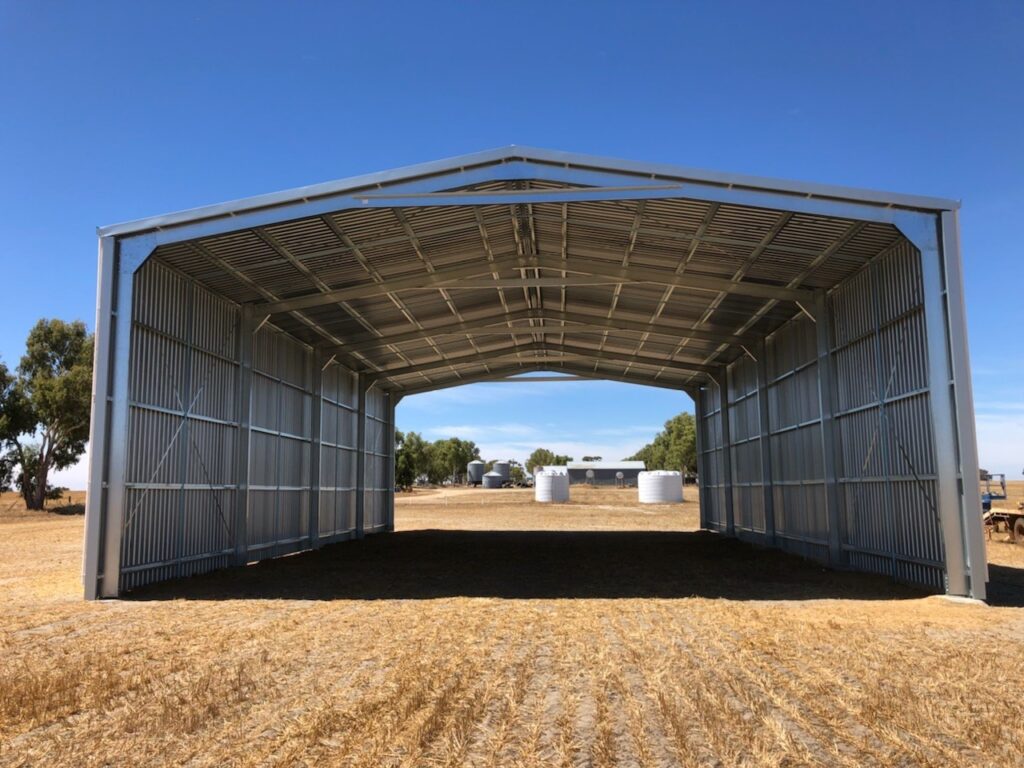
Queensland’s farming regions span from subtropical dairy country in the Darling Downs to tropical cattle stations in Far North Queensland. The climate puts unique demands on farm buildings: cyclone-rated engineering in the north, ventilation for oppressive humidity, corrosion resistance near the coast, and wide spans for modern machinery. A farm shed that works in Victoria won’t necessarily work in QLD.
This guide covers what Queensland farmers need to know when building a new farm shed, from engineering and wind ratings to design features that suit the QLD climate.
Queensland Wind Regions
Wind loading is the single biggest factor in farm shed engineering in Queensland. The state spans multiple wind regions under AS/NZS 1170.2:
- Region A (non-cyclonic): Darling Downs, inland QLD south of the Tropic of Capricorn. Standard wind speeds, lowest engineering cost
- Region B (cyclonic): coastal Queensland from Bundaberg to Cairns, and some inland areas. Higher design wind speeds, heavier frames and connections required
- Region C (severe cyclonic): Far North Queensland, north of Cairns, Torres Strait. The highest wind ratings for mainland Australia
- Region D (very severe): extreme exposure areas, offshore islands. Rare for farm buildings
A farm shed in Mackay (Region B) needs significantly heavier steelwork than the same shed in Toowoomba (Region A). Terrain category also matters, open farmland with no windbreaks (TC1: TC2) attracts higher loads than sheltered sites with trees and buildings (TC2.5: TC3).
Read more in our cyclone-rated sheds guide.
Designing for Queensland Heat
Queensland summers mean months of 30°C+ temperatures, high humidity, and intense solar radiation. Good shed design can make a farm building comfortable to work in without air conditioning:
Ventilation
- Ridge ventilation: a continuous or intermittent ridge vent along the roof peak lets hot air escape naturally. Essential in QLD
- High wall openings: louvre vents or open wall sections near the eave line encourage cross-ventilation
- Open bays: open-front sheds are naturally the coolest option for machinery storage and hay
- Turbine ventilators: whirlybirds are cheap and effective on enclosed sheds
Insulation
- Under-roof blanket insulation: reduces radiant heat transfer by up to 95%. Even a single layer of foil-faced blanket makes a dramatic difference
- Wall insulation: worth it for workshops and any enclosed area where people work. Not necessary for open storage
- Light-coloured roof: Surfmist or Shale Grey COLORBOND® reflects significantly more heat than darker colours. In QLD, roof colour choice is a performance decision, not just aesthetics
Roof Pitch
A steeper roof pitch (15 to 20°) sheds water faster in tropical downpours and creates a larger volume of air above the workspace. The extra air mass acts as a heat buffer. Many QLD farm sheds use a higher pitch than equivalent sheds in southern states.
Common QLD Farm Shed Configurations
Broadacre Machinery Shed
Clear spans of 18m to 24m+ to house headers, planters, and sprayers. Open-front or partial enclosure. Minimum 4.5m wall height for modern GPS-equipped machinery with antennas. Often combined with a workshop bay at one end.
See our machinery sheds range.
Cattle Yard Shelter
Open-sided or three-sided sheds positioned over cattle yards to provide shade during handling. Wide spans (15m+) with minimum 4m clearance for cattle movement and truck loading.
Hay and Grain Storage
Open-front hay sheds with tall walls (5m to 7m) for maximum stacking height. Orientation matters in QLD, face the open side away from prevailing storm direction (typically south-east to east) to keep rain out.
Workshop + Office
Enclosed shed with insulated workshop bays, roller doors, and an office/smoko room section. For working properties where the shed doubles as farm headquarters.
Multi-Purpose Farm Building
The most popular QLD farm shed: a combination building with enclosed bays for storage and a workshop, open-front bays for machinery, and a lean-to awning for shade. Built long (30m to 60m) with different configurations along the length.
QLD-Specific Considerations
Termite Protection
One advantage of steel-framed sheds in Queensland: steel doesn’t attract termites. Timber-framed sheds in QLD need chemical treatment and termite barriers. Steel portal frames eliminate this entirely.
Corrosion in Coastal Areas
Within 1km of the coast, salt-laden air accelerates corrosion. Specify COLORBOND® Ultra for coastal and severe marine environments, it’s specifically rated for these conditions. Fasteners should be stainless steel or heavy-duty galvanised, not standard zinc-plated.
Council Approvals in QLD
Farm sheds on rural-zoned land in Queensland may qualify as accepted development (no approval required) if they meet certain size and setback criteria. However, this varies by local government area. Many councils require at least a building application with engineering certification. Check with your local council or see our council approval guide.
Flood-Prone Land
Large areas of QLD farming country are flood-prone. If your site has a flood overlay in the planning scheme, council may require a minimum floor level above the defined flood level. This affects slab design and can increase foundation costs.
Farm Shed Costs in Queensland
QLD farm shed prices depend heavily on wind region. The same building costs more the closer you get to the coast and the cyclone belt:
- Region A (inland): the standard wind region, comparable to southern states
- Region B (coastal): heavier steelwork for the same building size
- Region C (FNQ): cyclone engineering is the major cost driver
For an accurate quote, design your shed online or give us a call. We deliver across all of Queensland.
QLD Farm Shed FAQs
Do I need engineering for a farm shed in QLD?
Yes. All structural buildings in Queensland need certified engineering. This is especially important in cyclone regions where the engineering determines connection details, bracing, and cladding fastener spacing.
What wind region am I in?
Use the wind region map in AS/NZS 1170.2 or ask us, we’ll determine your wind region and terrain category as part of the quoting process.
Can I owner-build a farm shed in QLD?
Yes. Queensland’s QBCC allows owner-builders to construct on their own land. You’ll need to apply for an owner-builder permit for buildings over a certain value. Our owner builder guide covers the process.