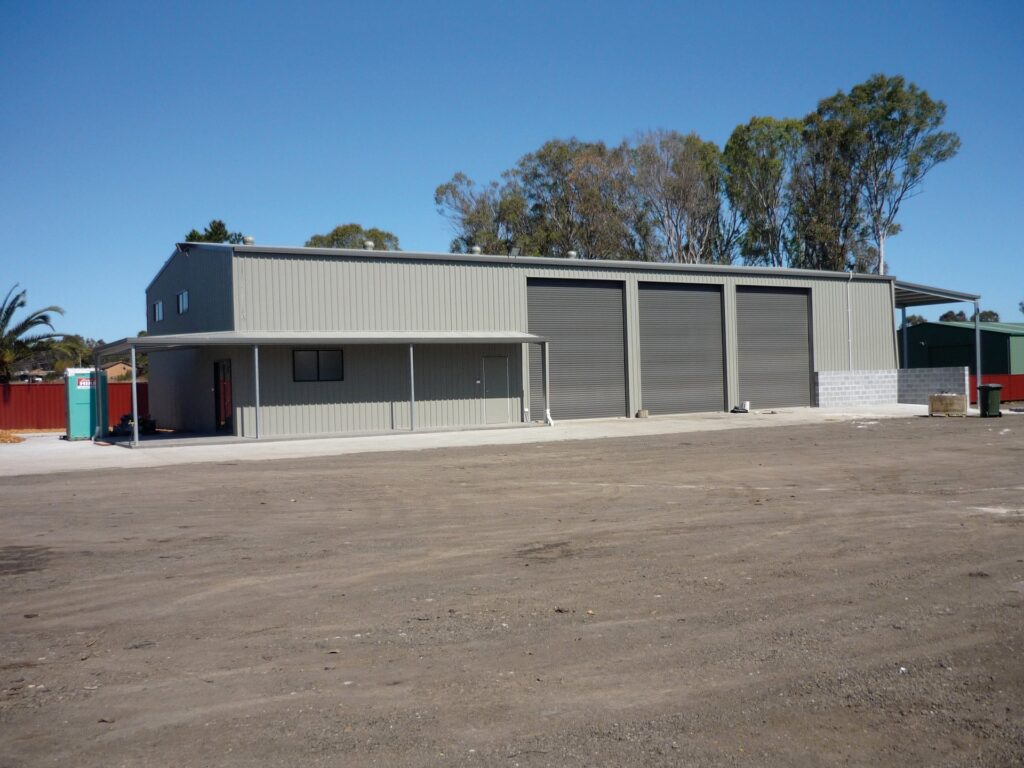
Commercial and industrial sheds serve businesses, they need to be functional, compliant, and built to handle heavy use for decades. The design requirements are fundamentally different from residential or farm buildings.
Commercial vs Industrial: What’s the Difference?
Commercial Sheds
Trade workshops, retail storage, vehicle servicing, small manufacturing, and business premises. Typically 150-500m² with moderate spans and heights. Often need customer-facing elements (reception areas, bathrooms, parking).
Industrial Sheds
Large-scale manufacturing, warehousing, distribution centres, and heavy industry. Typically 500m²+ with wide clearspans (20m+), high eave heights (6m+), and heavy-duty floor loads. May need crane rails, loading docks, and specialised services.
Key Design Considerations
Clearspan Width
Internal columns restrict forklift movement, racking layouts, and future flexibility. For any commercial or industrial building, clearspan construction is almost always worth the investment. We engineer clearspans from 12m to 30m+ depending on your requirements.
Eave Height
Don’t underestimate height needs:
- 4.2m: Minimum for most commercial use
- 5-6m: Standard warehouse/distribution, allows two-level racking
- 7-8m+: High-bay warehousing with reach stackers
Access & Loading
- Roller doors: standard 4.2m × 4.2m minimum for commercial vehicles
- Container-height doors: 4.2m wide × 4.8m high for container unloading
- Drive-through layouts for logistics operations
- Loading docks for truck-to-warehouse transfers
Fire Rating
Commercial and industrial buildings often require fire-rated construction, especially near boundaries or in multi-tenancy developments. Fire-rated walls, boundary setbacks, and hydrant requirements are set by the Building Code of Australia (BCA) and your local council. Our engineering includes BCA compliance documentation.
Office & Amenities Integration
Most commercial buildings need an office, bathroom, and kitchenette. These are typically fitted out within the steel frame as insulated, lined rooms. Plan the layout early, services (electrical, plumbing, data) are easier and cheaper to install during construction.
Council Requirements for Commercial Buildings
Commercial and industrial DAs are more complex than residential shed approvals:
- Traffic impact assessment for vehicle movements
- Stormwater management plan
- Landscaping and setback requirements
- Parking calculations (based on floor area and use)
- Accessibility compliance (disabled access, DDA)
- Environmental assessments in some zones
Check your state-specific requirements: QLD · NSW · VIC · SA · WA