Category: Design & Planning

  • How to Insulate a Steel Shed: Stop Condensation & Stay Comfortable

    Why Insulate Your Steel Shed?

    Steel is an excellent building material — strong, durable, termite-proof, and fire-resistant. But it conducts heat and cold efficiently, which means an uninsulated steel shed can be unbearably hot in summer, freezing in winter, and prone to condensation year-round.

    Insulation solves all three problems. For livable shed homes, insulation isn’t optional — it’s a Building Code requirement. But even for workshops, garages, and hobby sheds, insulation makes your space usable 12 months a year.

    The Condensation Problem

    Condensation is the number one complaint from steel shed owners who skip insulation. When warm, moist air inside the shed hits the cold steel surface, water forms on the underside of the roof. This leads to:

    • Dripping onto stored items, tools, and vehicles
    • Rust formation on the inside of the steel (from the outside, your COLORBOND® coating is fine)
    • Mould and mildew growth
    • Damage to hay, grain, and feed in farm sheds

    The solution is a vapour barrier combined with insulation — creating a thermal break between the warm inside air and the cold steel.

    Insulation Types for Steel Sheds

    Reflective Foil (Sisalation / Anticon)

    The most common insulation for steel sheds. A layer of reflective foil laminate is laid over the purlins before the roof sheeting is installed. Anticon is the brand name for foil-backed blanket insulation specifically designed for steel roofing.

    • R-value: R1.0 to R1.5 (reflective only) or R1.5 to R2.5 (with blanket)
    • Best for: garages, workshops, storage sheds — stops condensation and provides basic thermal comfort
    • Cost: $8–$15/m² installed

    Glasswool Batts

    For livable sheds and spaces that need higher thermal performance, glasswool batts are installed between the steel frame and internal lining. This is the standard approach for meeting BCA energy efficiency requirements.

    • R-value: R2.0 to R6.0 depending on thickness
    • Best for: livable shed homes, offices, studios — meets NCC/BCA energy requirements
    • Cost: $15–$30/m² installed (including vapour barrier)

    Spray Foam

    Closed-cell spray foam provides excellent insulation and acts as its own vapour barrier. It’s applied directly to the inside of the steel cladding.

    • R-value: R3.5 to R6.0+ per 50mm thickness
    • Best for: cold climates, high-performance builds, odd-shaped spaces
    • Cost: $25–$50/m² installed — the most expensive option but the best thermal performance

    Which R-Value Do You Need?

    The required R-value depends on your climate zone (as defined by the NCC) and whether your shed is habitable:

    • Non-habitable sheds — no minimum requirement, but R1.0+ stops condensation
    • Climate zones 1–3 (tropical/subtropical QLD, NT, northern WA): walls R2.8, ceiling R4.1 minimum
    • Climate zones 4–5 (temperate NSW, VIC, SA): walls R2.8, ceiling R4.1–R5.1
    • Climate zones 6–8 (cool/alpine TAS, highlands): walls R2.8–R3.8, ceiling R5.1–R6.3

    Your building certifier will confirm the exact requirements for your location.

    Installation Tips

    • Install roof insulation before sheeting — it’s much easier to lay foil/blanket over the purlins before the roof goes on
    • Don’t compress batts — squashing them reduces their R-value significantly
    • Seal all gaps — insulation only works if air can’t bypass it. Tape joins in foil, fill gaps around doors and windows
    • Ventilate — even insulated sheds need some airflow. Whirlybirds, ridge vents, or louvre vents prevent moisture build-up
    • Consider wall insulation too — roof-only insulation helps but walls are responsible for 25–35% of heat transfer

    Planning a shed that needs insulation? Design it in our 3D tool and we’ll help you choose the right insulation approach for your climate and use case.

  • Shed Foundations: Concrete Slabs, Piers & Getting It Right

    Why Your Shed Foundation Matters

    Your foundation is the most critical part of any shed build. Get it wrong and you’ll deal with cracking, shifting, water pooling, and structural problems for the life of the building. Get it right and your shed will perform exactly as engineered for decades.

    For steel frame sheds, the foundation must match the engineering specifications. Every Shedz kit comes with site-specific engineering drawings that specify exactly what your slab or footings need to look like — including dimensions, reinforcement, hold-down bolt locations, and concrete strength.

    Types of Shed Foundations

    Concrete Slab on Ground

    The most common foundation for steel sheds in Australia. A reinforced concrete slab provides a level, durable surface that doubles as your floor. Typical specifications:

    • Thickness: 100mm for residential sheds, 150mm+ for heavy vehicle or industrial use
    • Concrete strength: N25 or N32 depending on engineering requirements
    • Reinforcement: SL82 or SL72 mesh, with additional reinforcement at edges and thickenings
    • Edge beam: typically 300mm x 300mm with N12 reinforcing bars
    • Hold-down bolts: cast into the slab at precise locations matching your frame layout

    Important: Always refer to your signed-off engineering drawings for the concrete slab and footings design and specifications for your specific shed. The above are general guidelines only — your engineer’s specifications take priority.

    Pier Footings

    Pier footings (also called pad footings or post footings) are individual concrete pads poured at each column location. They’re common for:

    • Sloping sites where a full slab isn’t practical
    • Rural properties where a gravel or earth floor is preferred
    • Farm sheds where machinery needs to drive in and out
    • Budget-conscious builds where you want to minimise concrete costs

    Each pier is typically 600mm x 600mm x 600mm deep, with hold-down bolts cast in. Your engineering drawings will specify the exact size and depth based on your soil classification and wind loads.

    Strip Footings

    A continuous strip of concrete along the shed walls. Less common for standard sheds but sometimes used for livable shed homes where the wall loads are distributed along the entire length.

    Site Preparation

    Before any concrete is poured, your site needs to be prepared:

    1. Soil test — a geotechnical report classifies your soil (A, S, M, H, E, or P class). This determines your footing design.
    2. Clearing and levelling — remove vegetation, topsoil, and level the pad area
    3. Compaction — compact the sub-base to the required density
    4. Drainage — ensure water drains away from the slab. Consider ag-pipe around the perimeter.
    5. Services — if your shed needs water, sewer, or electrical, run the pipes and conduits before the slab is poured

    Getting the Hold-Down Bolts Right

    This is where most DIY slabs go wrong. Hold-down bolts must be placed at exact positions matching your steel frame layout. Even 10mm out and you’ll have problems bolting down the columns.

    Tips for getting it right:

    • Use a template or jig — many shed suppliers provide bolt layout drawings
    • Double-check dimensions before the pour — measure diagonals to ensure square
    • Set bolts to the correct height — too low and the thread won’t engage, too high and the baseplate won’t sit flat
    • Protect bolt threads during the pour — wrap with tape or use bolt caps

    Cost Guide

    Concrete slab costs vary significantly based on site conditions, location, and concrete prices in your area. As a rough guide:

    • Small residential shed (6m x 6m): $3,000–$6,000
    • Medium shed (12m x 9m): $8,000–$15,000
    • Large farm/commercial shed (18m x 12m+): $15,000–$30,000+

    These figures include excavation, formwork, reinforcement, concrete supply, and finishing. Add 20–30% for difficult sites (slope, rock, poor access).

    Choosing a Concretor

    For owner builders, the slab is one job worth getting a professional for. Look for:

    • Experience with shed slabs (not just house slabs — the bolt layouts are different)
    • Willingness to work from your engineering drawings
    • A clear quote that itemises concrete volume, reinforcement, and finishing
    • Insurance and licensing appropriate for your state

    Need help planning your shed foundation? Contact Shedz and we’ll provide the engineering drawings your concretor needs to get it right first time.

  • Commercial & Industrial Shed Design: What to Consider

    Commercial & Industrial Shed Design: What to Consider

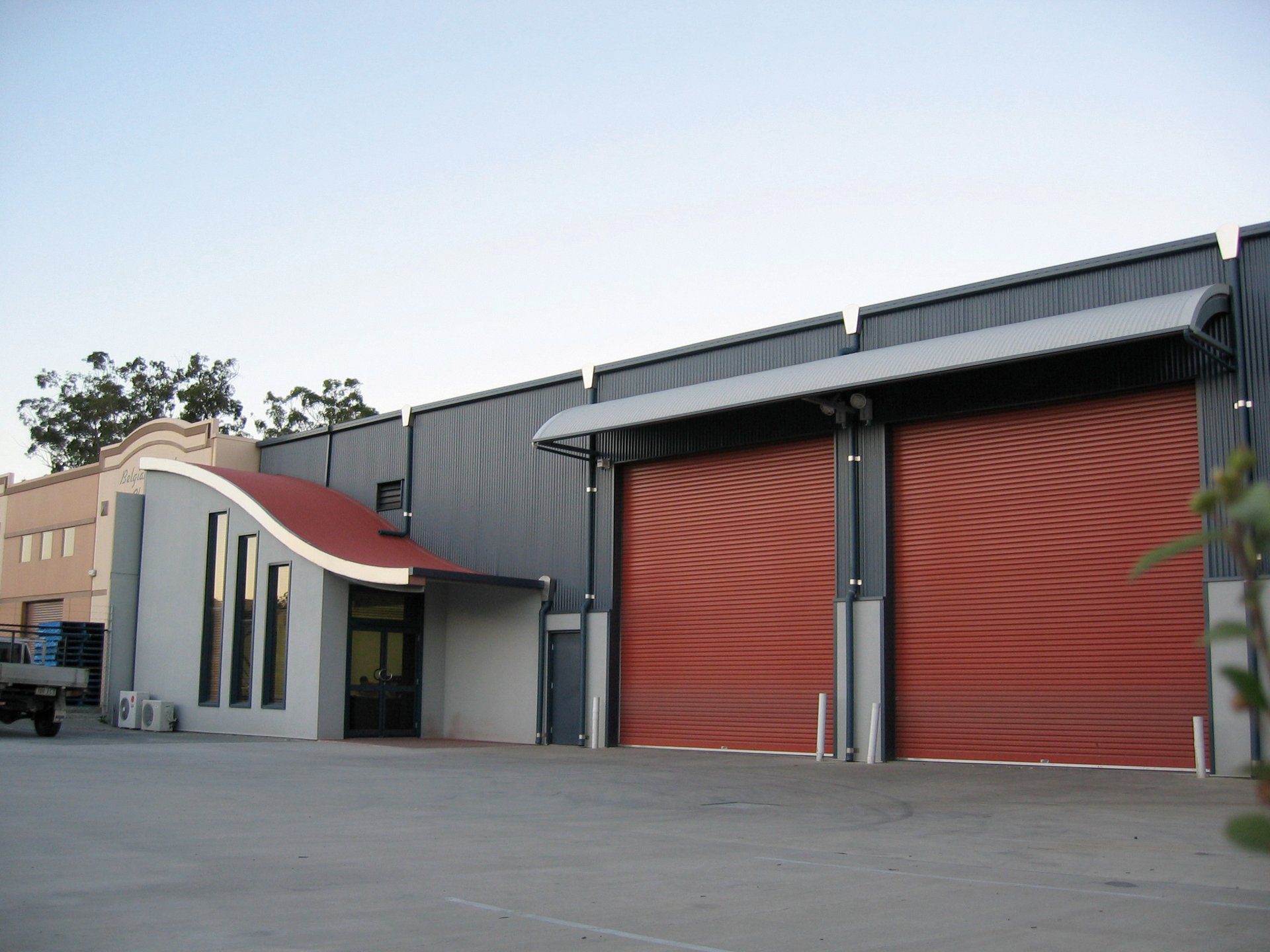
    Commercial and industrial sheds serve businesses — they need to be functional, compliant, and built to handle heavy use for decades. The design requirements are fundamentally different from residential or farm buildings.

    Commercial vs Industrial: What’s the Difference?

    Commercial Sheds

    Trade workshops, retail storage, vehicle servicing, small manufacturing, and business premises. Typically 150-500m² with moderate spans and heights. Often need customer-facing elements (reception areas, bathrooms, parking).

    Industrial Sheds

    Large-scale manufacturing, warehousing, distribution centres, and heavy industry. Typically 500m²+ with wide clearspans (20m+), high eave heights (6m+), and heavy-duty floor loads. May need crane rails, loading docks, and specialised services.

    Key Design Considerations

    Clearspan Width

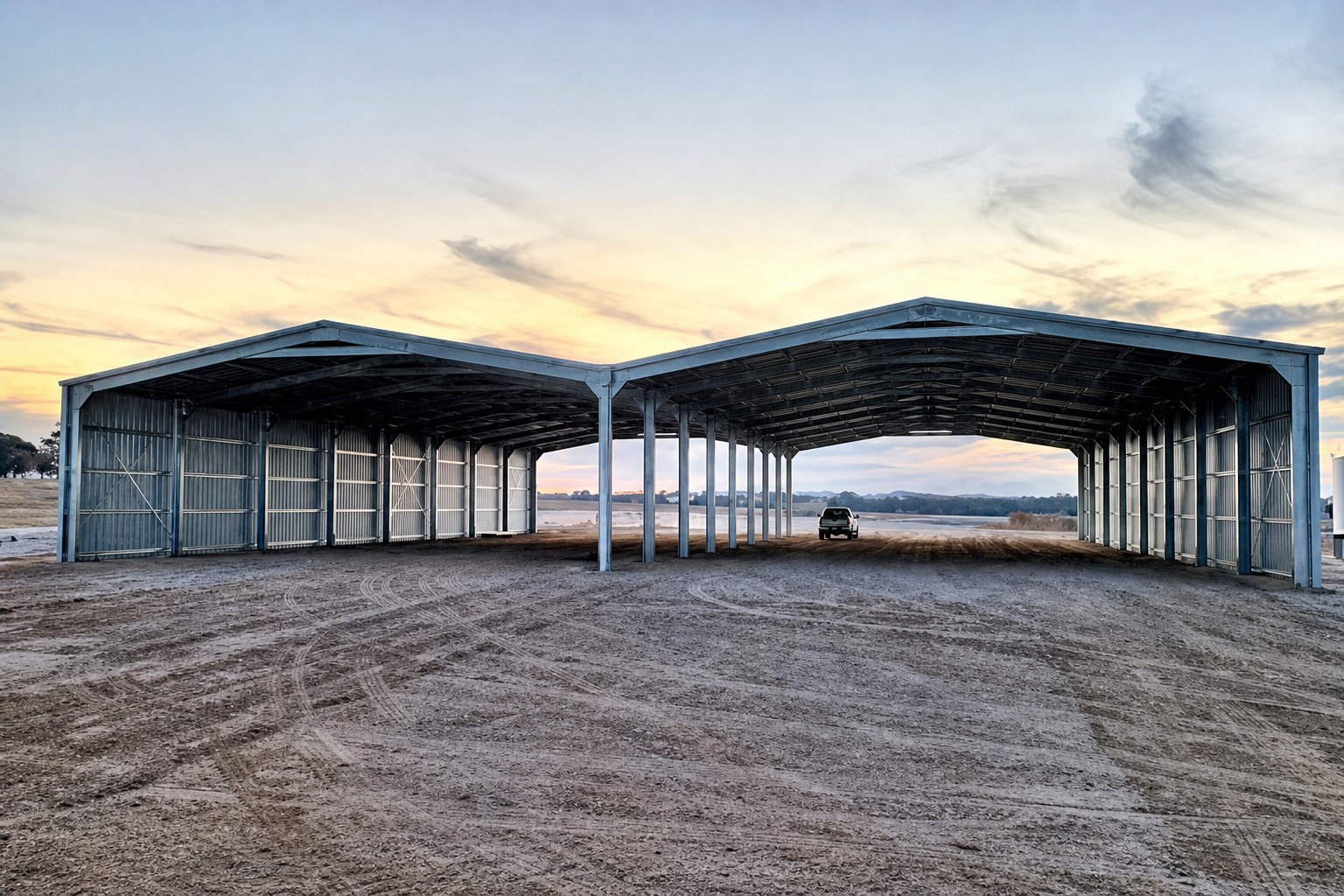
    Internal columns restrict forklift movement, racking layouts, and future flexibility. For any commercial or industrial building, clearspan construction is almost always worth the investment. We engineer clearspans from 12m to 30m+ depending on your requirements.

    Eave Height

    Don’t underestimate height needs:

    • 4.2m: Minimum for most commercial use
    • 5-6m: Standard warehouse/distribution — allows two-level racking
    • 7-8m+: High-bay warehousing with reach stackers

    Access & Loading

    • Roller doors: standard 4.2m × 4.2m minimum for commercial vehicles
    • Container-height doors: 4.2m wide × 4.8m high for container unloading
    • Drive-through layouts for logistics operations
    • Loading docks for truck-to-warehouse transfers

    Fire Rating

    Commercial and industrial buildings often require fire-rated construction — especially near boundaries or in multi-tenancy developments. Fire-rated walls, boundary setbacks, and hydrant requirements are set by the Building Code of Australia (BCA) and your local council. Our engineering includes BCA compliance documentation.

    Office & Amenities Integration

    Most commercial buildings need an office, bathroom, and kitchenette. These are typically fitted out within the steel frame as insulated, lined rooms. Plan the layout early — services (electrical, plumbing, data) are easier and cheaper to install during construction.

    Council Requirements for Commercial Buildings

    Commercial and industrial DAs are more complex than residential shed approvals:

    • Traffic impact assessment for vehicle movements
    • Stormwater management plan
    • Landscaping and setback requirements
    • Parking calculations (based on floor area and use)
    • Accessibility compliance (disabled access, DDA)
    • Environmental assessments in some zones

    Check your state-specific requirements: QLD · NSW · VIC · SA · WA

  • What Size Shed Do I Need? The Complete Sizing Guide

    What Size Shed Do I Need? The Complete Sizing Guide

    The number one regret shed owners have? “I wish I’d built it bigger.” Getting your shed size right the first time saves you thousands of dollars and years of frustration.

    Here’s how to calculate the right size based on what you’re actually using it for.

    The Golden Rule: Go Bigger Than You Think

    Whatever size you’re considering, go at least one bay wider and one bay deeper. Your needs will grow — equipment gets upgraded, collections expand, businesses grow. The cost difference between a 12m and 15m wide shed is a fraction of the cost of building a second shed later.

    Residential Shed Sizes

    For residential sheds — garages, workshops, hobby spaces:

    Single Garage

    Minimum: 3.5m × 6m. Comfortable: 4m × 7m. This fits one car with room to open doors and walk around it.

    Double Garage

    Minimum: 6m × 6m. Comfortable: 7m × 7m. Room for two vehicles plus some wall storage.

    Workshop

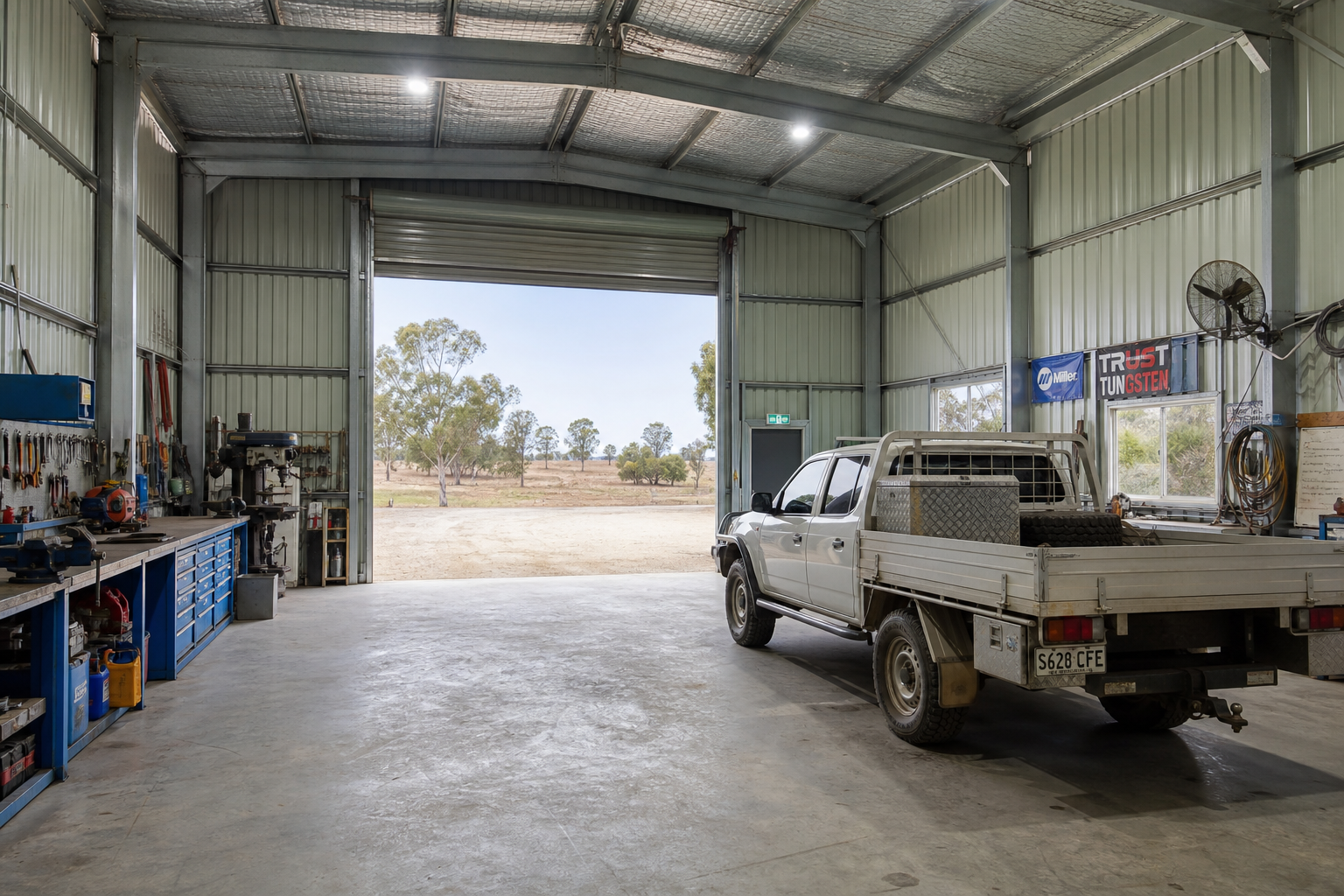
    Minimum: 9m × 6m. Comfortable: 12m × 8m. You need room for a workbench, tool storage, and space to actually work around your projects.

    Man Cave / Hobby Shed

    Budget 30-50m² minimum. Consider what you’ll put in it — a car restoration project, woodworking equipment, or a home gym all have different spatial needs.

    Farm Shed Sizes

    For farm sheds, hay storage, and machinery sheds:

    Machinery Storage

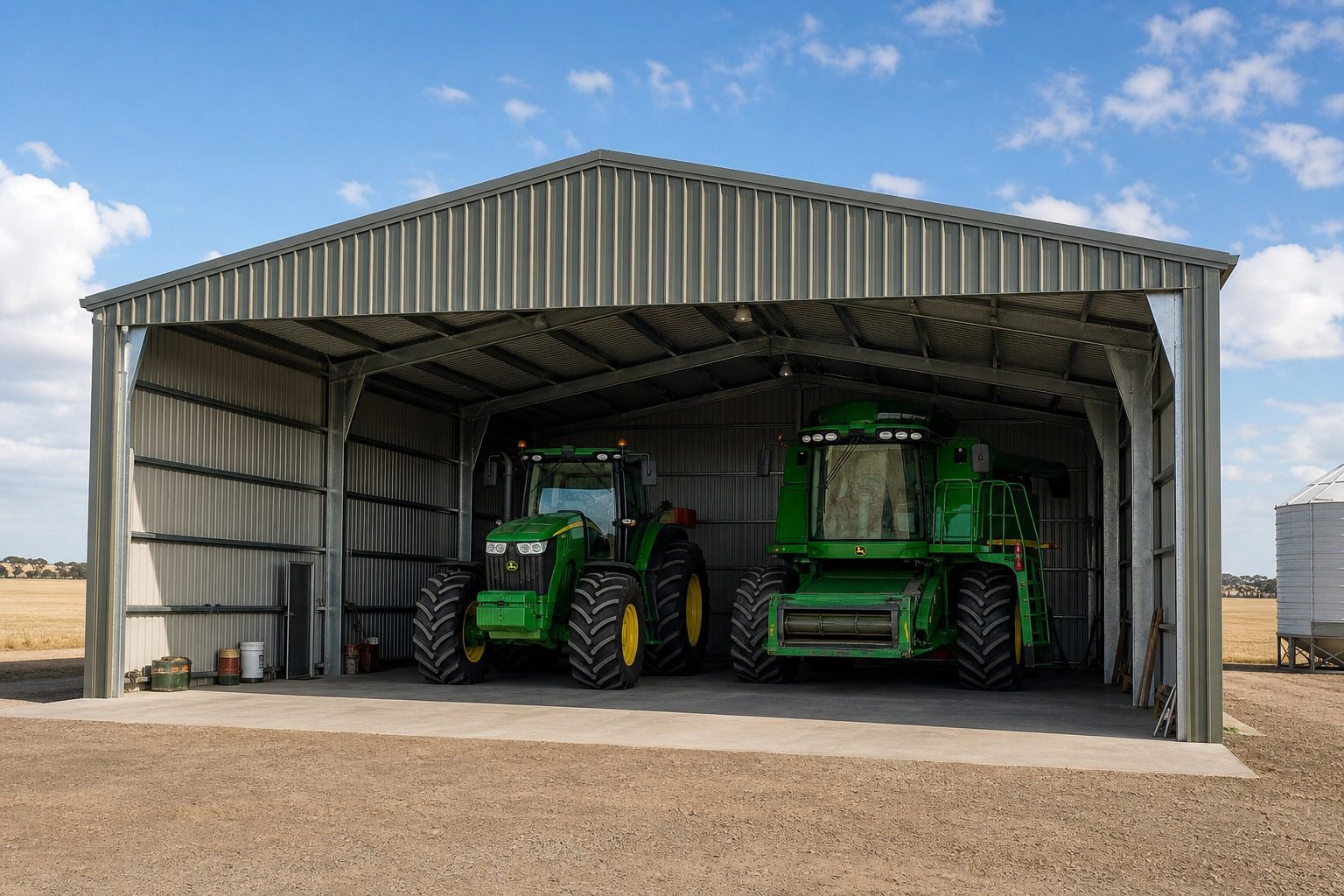
    Measure your tallest and widest piece of equipment, then add 1m each side and 300mm above. For a typical tractor + implements setup, you’re looking at minimum 15m × 12m with 4.5m eave height. Headers and large harvesters need 18-24m wide with 5-6m eave height.

    Hay Storage

    Calculate your maximum bale count and stacking height. Round bales (1.2m dia × 1.2m) stacked 4 high need 5m+ eave height. A 200-bale capacity shed at 4-high stacking needs approximately 15m × 18m.

    General Farm Storage

    Multi-purpose farm sheds that combine machinery, hay, and workspace typically start at 18m × 12m. Bigger operations need 24m+ wide with multiple bays.

    Commercial & Industrial Sizes

    For commercial and industrial sheds:

    Workshop / Trade Premises

    15m × 20m minimum for most trade operations. Consider vehicle access, parts storage, office space, and customer parking.

    Warehouse

    Clearspan construction is essential for warehousing. Start at 20m × 30m for small operations. Eave height of 6m+ allows racking systems.

    Industrial

    Industrial buildings often exceed 30m wide with spans engineered for specific equipment and processes. Crane rails, mezzanine floors, and heavy-duty flooring are common additions.

    Height Matters

    Don’t just think about floor area — eave height is equally important:

    • 3m: Minimum for residential sheds and single-vehicle garages
    • 3.6m: Comfortable for workshop use and larger vehicles
    • 4.2m: Standard for farm machinery and small commercial
    • 5-6m: Hay storage, large machinery, commercial operations
    • 6m+: Industrial, warehousing, crane clearance
  • Shed Home vs Granny Flat: Which One Should You Build?

    Shed Home vs Granny Flat: Which One Should You Build?

    We get asked this all the time: “Should I build a shed home or a granny flat?” They’re fundamentally different products for different situations, and choosing the wrong one can cost you tens of thousands of dollars and months of wasted time.

    Here’s the real comparison from someone with 38 years in the building industry.

    What Is a Shed Home?

    A shed home is a full-sized residential dwelling built within a steel-framed portal structure. These are not small backyard builds — they’re large-scale homes typically on rural or semi-rural acreage, often 150m²+ of living space with multiple bedrooms, bathrooms, kitchen, and living areas.

    The steel frame acts as the building envelope, with internal fitout to residential building standards. Think of it as building a home inside an engineered steel shell.

    What Is a Granny Flat?

    A granny flat (also called a secondary dwelling or ancillary dwelling) is a small self-contained dwelling on an existing residential block. They’re typically limited to 60m² in most states and are governed by specific secondary dwelling regulations.

    Key Differences

    Size

    • Shed Home: No practical size limit. We build from 100m² to 500m²+. Limited only by your land and budget.
    • Granny Flat: Typically capped at 60m² (varies by state). This is a hard planning limit in most councils.

    Location

    • Shed Home: Best suited to rural, semi-rural, or large lot residential properties. You need land — these aren’t suburban builds.
    • Granny Flat: Designed for existing suburban residential blocks. Most councils require a minimum lot size (usually 450m²+).

    Council Approval

    • Shed Home: Full DA and building approval required, same as any residential dwelling. Engineering certification included with every Shedz kit.
    • Granny Flat: May qualify for CDC (Complying Development) in some states, making approval faster. But size and design restrictions are strict.

    Cost

    • Shed Home: Steel kit from approximately $50,000-$150,000+ depending on size and specifications. Full fitout (electrical, plumbing, insulation, interior) is additional — budget $1,500-$2,500/m² for a complete build.
    • Granny Flat: Typically $80,000-$200,000+ for a complete turn-key build including all services and fitout.

    The Bottom Line

    A shed home gives you a full-sized residential dwelling on rural land with no size restrictions. A granny flat gives you a small secondary dwelling on an existing suburban block. They solve completely different problems.

    When a Shed Home Makes Sense

    • You own acreage or a large rural/semi-rural block
    • You want a primary residence, not a secondary dwelling
    • You need more than 60m² of living space
    • You want a combined living and farm workspace
    • You’re building in a cyclone-rated region and need engineered construction

    When a Granny Flat Makes Sense

    • You have a suburban residential block with enough space
    • You need a small self-contained dwelling (60m² or less)
    • You want rental income from a secondary dwelling
    • You’re housing a family member on your existing property
  • COLORBOND® Steel Shed Colours: Complete Guide to 22 Options

    COLORBOND® Steel Shed Colours: Complete Guide to 22 Options

    Every Shedz shed kit is built with genuine COLORBOND® steel by BlueScope — Australia’s leading steel brand, backed by warranties of up to 45 years. With 22 colours to choose from, the right colour does more than look good — it can affect heat absorption, blend with your landscape, and even influence council approval.

    Why COLORBOND®?

    COLORBOND® steel is specifically engineered for Australian conditions. It’s not just painted steel — the colour is baked onto the surface through a multi-layer process that resists chipping, peeling, and cracking in extreme heat, coastal salt air, and heavy rain.

    • Thermatech® technology — reflects more of the sun’s heat in darker colours
    • Australian-made — manufactured by BlueScope in Port Kembla, NSW
    • Up to 45 year warranty — manufacturer-backed warranty on roofing and walling
    • 22 colours — curated specifically for Australian landscapes and architecture

    The 22 COLORBOND® Colours

    Classic Neutrals

    Surfmist® — The lightest colour, near-white. Maximum heat reflection. Popular for roofing in hot climates and modern exteriors.

    Shale Grey™ — Warm light grey. One of Australia’s most popular shed colours. Versatile and understated.

    Dune® — Warm sandy beige. Blends with rural Australian landscapes. Popular for farm sheds and rural properties.

    Paperbark® — Soft warm neutral. Popular for walls when paired with darker roof colours.

    Evening Haze® — Sophisticated warm grey with subtle warmth.

    Greys

    Windspray® — Cool mid-grey. Clean, contemporary look for commercial and industrial sheds.

    Basalt® — Charcoal grey. Bold, modern aesthetic. Striking contrast with lighter walls.

    Ironstone® — Deep, dark grey-brown. Rich and grounded appearance.

    Woodland Grey® — Dark grey-green. Excellent for blending into bushland and rural settings.

    Monument® — Near-black dark grey. Maximum visual impact. Popular for modern shed homes.

    Earth Tones

    Terrain® — Earthy brown-green. Designed to blend with Australian bush landscapes.

    Jasper® — Rich brown. Works beautifully on rural properties and equine facilities.

    Pale Eucalypt® — Muted green. Blends naturally with eucalyptus-rich landscapes.

    Mangrove® — Deep green. Classic Australian rural colour for farm buildings.

    Cottage Green® — Heritage green. Traditional look for rural and heritage properties.

    Bold & Feature

    Classic Cream™ — Warm cream/yellow. Heritage feel, bright and welcoming.

    Deep Ocean® — Rich navy blue. Striking feature colour for walls and doors.

    Torres Blue® — Medium blue. Coastal feel, works well in tropical and cyclone-rated regions.

    Cove™ — Blue-grey coastal colour. Relaxed, modern feel.

    Gully® — Deep earthy green. Blends with dense vegetation and forested areas.

    Night Sky® — The darkest colour — near-black with a subtle blue undertone.

    Manor Red® — Classic Australian red. Iconic rural roofing colour.

    How to Choose the Right Colour

    Climate Considerations

    In hot climates (northern QLD, inland areas), lighter colours like Surfmist and Shale Grey reflect more heat. COLORBOND®’s Thermatech® technology helps, but lighter colours still perform better in extreme heat.

    Council & Planning

    Some councils require sheds to use colours that blend with the landscape — especially in rural, heritage, or scenic protection zones. Earth tones like Woodland Grey, Pale Eucalypt, and Terrain are safe choices in these areas.

    Mix and Match

    Most customers choose two colours — one for roofing and one for walling. Popular combinations include:

    • Monument roof + Surfmist walls (modern contrast)
    • Woodland Grey roof + Paperbark walls (rural blend)
    • Basalt roof + Shale Grey walls (contemporary clean)
    • Manor Red roof + Dune walls (classic Australian)

    Explore Our Shed Range

    Shed Homes · Residential Sheds · Farm Sheds · Commercial Sheds · Industrial Sheds · Equine Sheds · Hay Sheds · Machinery Sheds · Cyclone Rated

Our Trusted Suppliers

Lysaght logoMetroll logoStratco logoSteeline logoCenturion logoLarnec logoStramit logoBlueScope logoAMIA logo