Category: Council & Approvals

  • Owner Builder Shed Guide: Save Thousands by Managing Your Own Build

    What Is an Owner Builder?

    An owner builder is someone who takes on the responsibility of managing their own building project instead of hiring a licensed builder. In Australia, most states allow you to apply for an Owner Builder Permit for residential construction — including shed homes and large rural sheds.

    Being an owner builder doesn’t mean you have to do all the physical work yourself. It means you’re the project manager: you coordinate trades, manage timelines, ensure compliance, and take responsibility for the quality and safety of the build.

    Why Build Your Own Shed?

    The housing crisis has stretched the building industry thin. Wait times for licensed builders can exceed 12 months, and margins on builder quotes often add 25–40% to the actual cost of materials and labour. As an owner builder, you remove that margin entirely.

    For a steel frame shed kit, the savings can be substantial:

    • No builder margin — you pay trades directly at their rates
    • Control over quality — you choose the trades and materials for fitout
    • Flexible timeline — build at your pace, stage payments as you go
    • Full understanding of your building — you know every component intimately

    Owner Builder Requirements by State

    Each state has different rules for owner builders. Here’s a summary:

    Queensland

    Owner Builder Permit required for work valued over $11,000. Must complete a QBCC-approved Owner Builder course. No permit needed for sheds under certain size thresholds — check your local council for exempt development rules.

    New South Wales

    Owner Builder Permit required for work valued over $10,000. Must complete an approved owner builder course through NSW Fair Trading. Some shed work may qualify as exempt or complying development.

    Victoria

    Owner Builder Certificate of Consent required from the Victorian Building Authority (VBA). Must complete prescribed owner builder training. Building permit still required for the shed itself.

    South Australia, Western Australia, Tasmania, NT, ACT

    Requirements vary — generally a permit or notification is needed for work above a threshold value. Contact your state building authority for current requirements. See our state pages for links to relevant authorities.

    How Shedz Supports Owner Builders

    We designed our entire system around owner builders. Here’s what you get:

    Interactive 3D Component Mapping

    Every single component in your shed kit is mapped in our 3D designer. You can see exactly where each piece goes — columns, rafters, purlins, girts, bracing, flashings, right down to individual bolts and screws. Search by part number from the bill of materials and the 3D model highlights exactly where it fits.

    This isn’t a rough guide — it’s a precise, interactive model of your exact shed. If you can identify a part number, you can find where it goes. Visit our owner builder page to see screenshots of this in action.

    Certified Engineering Drawings

    Your kit comes with full engineering drawings stamped by a registered structural engineer. These cover:

    • Footing design and specifications
    • Steel frame connection details
    • Bracing layout
    • Wind and load calculations for your specific site
    • Concrete slab design (refer to your engineer’s specifications)

    These drawings are what your council needs for approval and what your concretor, steel erector, and inspector need during the build.

    Complete Bill of Materials

    Every component is itemised in a detailed BOM. No guessing, no missing pieces. When your kit arrives, you can check every item off the list.

    The Owner Builder Process: Step by Step

    1. Design your shed — use our 3D designer to configure your layout, size, and features
    2. Get your quote — we price your design based on size, wind rating, and specifications
    3. Apply for your Owner Builder Permit — complete the required course for your state
    4. Submit your DA/CDC — using the engineering drawings we provide
    5. Prepare your site — clearing, levelling, and access for delivery
    6. Pour your slab — using the footing specifications from the engineering drawings
    7. Receive your kit — delivered to your site, every component labelled
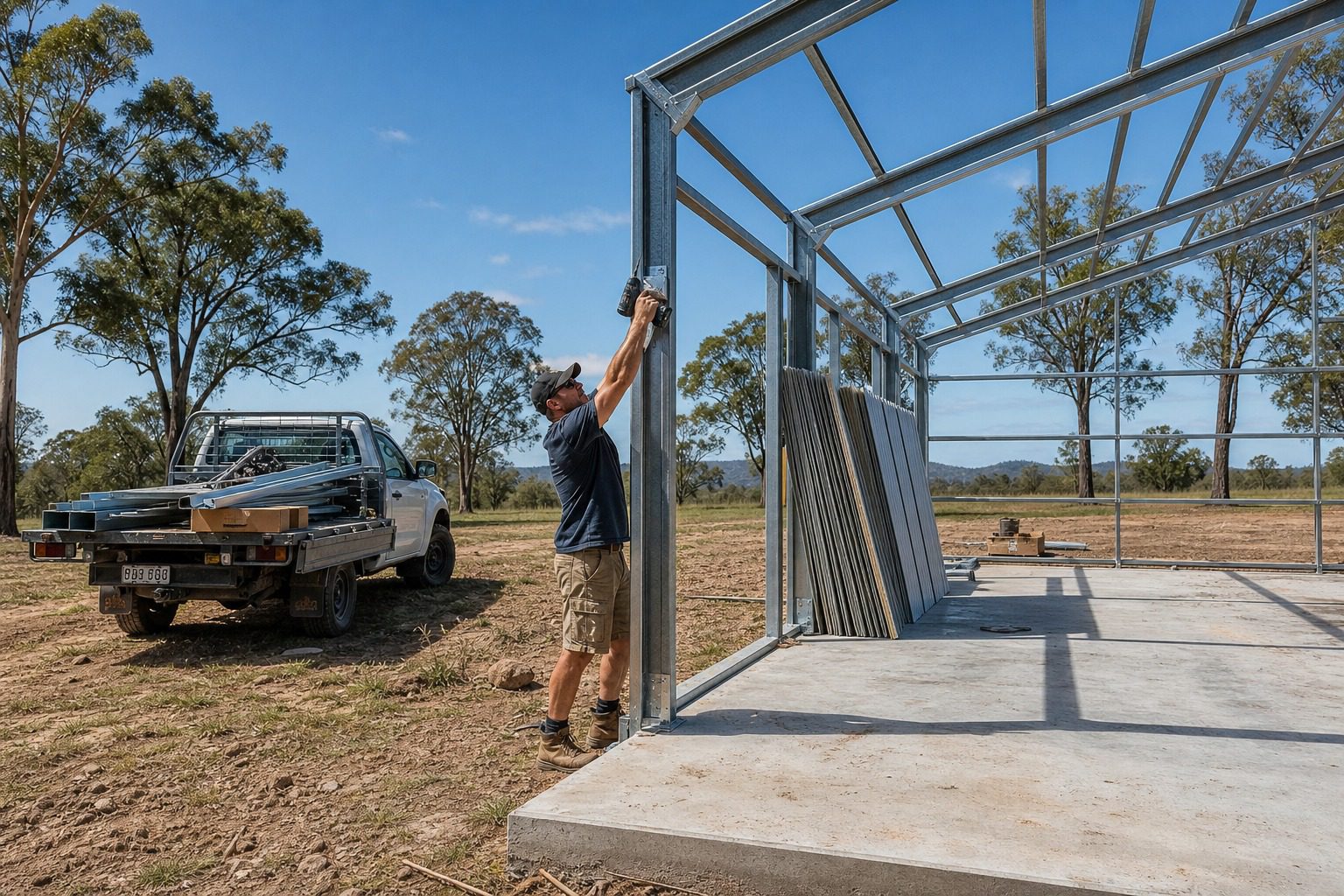
    8. Erect the frame — using the assembly guide and 3D model reference
    9. Close in — roof sheeting, wall cladding, doors, and windows
    10. Fit out — insulation, lining, electrical, plumbing, and finishes
    11. Final inspection and OC — your council signs off the completed build

    Common Owner Builder Mistakes to Avoid

    • Skipping the soil test — this determines your footing design. Don’t guess.
    • Underestimating fitout costs — budget 60–70% of total cost for everything after the shell
    • Not checking council requirements first — setbacks, height limits, and zoning can affect your design
    • Choosing the cheapest quote — for steel sheds, engineering quality matters more than price. A poorly engineered shed can fail in high winds.
    • Not insuring the build — owner builder insurance is essential. You’re liable for everything on site.

    Ready to take control of your build? Start designing your shed in 3D and see exactly what you’re building before you commit.

  • Cyclone-Rated Sheds: What You Need to Know Before Building

    Cyclone-Rated Sheds: What You Need to Know Before Building

    If your property is in a designated cyclone region, your shed isn’t just a building — it’s potentially a shelter. Cyclone-rated construction isn’t optional in these areas; it’s a mandatory engineering requirement that affects every component of your shed.

    Wind Regions Explained

    Australia is divided into wind regions that determine the minimum engineering standard for any structure:

    • Region A — Most of southern Australia. Standard wind loads.
    • Region B — Elevated wind areas. Parts of southern coastal regions and some inland areas.
    • Region C — Cyclone-prone areas. Most of tropical northern Australia including coastal QLD north of Bundaberg, NT, and northern WA.
    • Region D — Severe cyclone areas. Specific high-risk coastal zones within Region C.

    Your wind region is determined by your exact site coordinates. Even within the same council area, properties can fall in different regions based on terrain category, shielding, and topography.

    What Makes a Shed Cyclone-Rated?

    It’s not just about using thicker steel. Cyclone-rated construction requires engineering changes throughout the entire structure:

    Connections

    Every connection — column to footing, rafter to column, purlin to rafter, cladding to purlin — must be engineered to resist the specific wind loads for your site. In cyclone regions, these connections use heavier brackets, more fasteners, and sometimes welded joints instead of bolted.

    Footings

    Cyclone-rated sheds require significantly larger footings to resist uplift forces. In extreme wind, the force trying to lift your shed off the ground can be enormous. Footing designs are calculated for your specific soil conditions and wind loads.

    Bracing

    Additional cross-bracing, portal frames, or moment connections are required to resist lateral (sideways) wind forces during a cyclone. The bracing design depends on the building dimensions and the wind load.

    Cladding & Fasteners

    Roofing and wall sheeting must be fixed with more fasteners at closer spacings, particularly at edges and corners where wind loads are highest. The cladding profile itself may need to be upgraded to a higher wind-rated product.

    Regions That Require Cyclone Rating

    Queensland

    Coastal QLD north of approximately Bundaberg falls within Region C or D. This includes Gladstone, Rockhampton, Mackay, Townsville, and Cairns. See our full QLD coverage →

    Western Australia

    Northern WA from approximately Geraldton northward — including Carnarvon, Karratha, Port Hedland, Broome, and the Kimberley — requires cyclone-rated construction. See our full WA coverage →

    Northern Territory

    Most of the NT, including Darwin, falls within cyclone wind regions.

    Does Cyclone Rating Cost More?

    Yes, typically 15-30% more than a standard wind-region shed of the same size. The additional cost comes from heavier steel sections, more fasteners, larger footings, and more complex engineering. But this is a non-negotiable requirement — it’s there to protect your property, your livestock, and your equipment.

    Engineering Certification

    Every Shedz kit includes engineering certification calculated for your specific site coordinates and wind region. We don’t use generic “one-size-fits-all” engineering — your shed is designed for exactly where it’s going to stand.

    Explore Our Shed Range

    Cyclone Rated Sheds · Farm Sheds · Commercial Sheds · Industrial Sheds · Shed Homes

  • Do I Need Council Approval for a Shed in Australia?

    Do I Need Council Approval for a Shed in Australia?

    One of the most common questions we get from customers: “Do I need council approval to build a shed?” The short answer is — almost always yes, but the process varies significantly depending on which state you’re in, how big your shed is, and what you’re using it for.

    With 38 years of building experience, we’ve navigated council approvals in every state and territory. Here’s your complete guide.

    The General Rule

    In most Australian states, any structure over 10m² requires some form of approval. Even smaller sheds may need approval depending on your zoning, setbacks, and whether you’re in a bushfire or flood zone.

    Every Shedz kit includes full engineering certification — the documentation your council or private certifier needs to approve your build.

    State-by-State Requirements

    Queensland

    QLD requires a Development Application (DA) for most sheds. Your engineer’s certification covers the structural requirements, and your builder or building certifier handles the council lodgement. Read our full QLD guide →

    New South Wales

    NSW offers two pathways: a Complying Development Certificate (CDC) for standard sheds (faster, through a private certifier), or a Development Application (DA) for larger or more complex builds. Read our full NSW guide →

    Victoria

    VIC requires a Building Permit for most sheds, plus potentially a Planning Permit depending on your zoning and overlays. Farm-zoned properties may have exemptions. Read our full VIC guide →

    South Australia

    SA uses a combined Development Approval process covering both planning consent and building rules consent. Some smaller domestic sheds may be exempt. Read our full SA guide →

    Western Australia

    WA requires a Building Permit for most sheds over 10m². Properties in northern WA need cyclone-rated construction. Read our full WA guide →

    Tasmania

    TAS requires a Building Permit for most sheds, with potential Planning Permit requirements depending on local schemes. Read our full TAS guide →

    ACT

    The ACT requires Building Approval for most structures, with Development Application requirements depending on Territory Plan zoning. Read our full ACT guide →

    Key Factors That Affect Approval

    Bushfire Attack Level (BAL)

    If your property is in a designated bushfire-prone area, your shed must be engineered to meet specific BAL requirements. This affects materials, construction methods, and sometimes design. We factor this into every engineering package.

    Cyclone Ratings

    Properties in northern Australia (coastal QLD, NT, northern WA) require cyclone-rated construction. Our sheds are engineered to Region B, C, or D as required for your specific location.

    Setbacks and Boundaries

    Every council has minimum setback requirements — how far your shed must be from property boundaries, other buildings, and easements. These vary by zone and local planning rules.

    Zoning

    Rural, residential, commercial, and industrial zones all have different rules about what you can build, how big it can be, and what it can be used for.

    What Documentation Do You Need?

    Every Shedz kit includes:

    • Full structural engineering certification by a registered engineer
    • Engineering drawings and specifications
    • Wind load calculations for your specific site
    • Footing design specifications
    • Material specifications and compliance certificates

    This is everything your council or private certifier needs to process your approval.

    How Long Does Approval Take?

    Timeframes vary by council and application type:

    • CDC/Complying Development: 10-20 business days (through private certifier)
    • Standard DA: 4-8 weeks
    • Complex applications: 2-4+ months (heritage, flood, environmental overlays)

    Explore Our Shed Range

    Shed Homes · Residential Sheds · Farm Sheds · Commercial Sheds · Industrial Sheds · Equine Sheds · Hay Sheds · Machinery Sheds · Cyclone Rated

Our Trusted Suppliers

Lysaght logoMetroll logoStratco logoSteeline logoCenturion logoLarnec logoStramit logoBlueScope logoAMIA logo