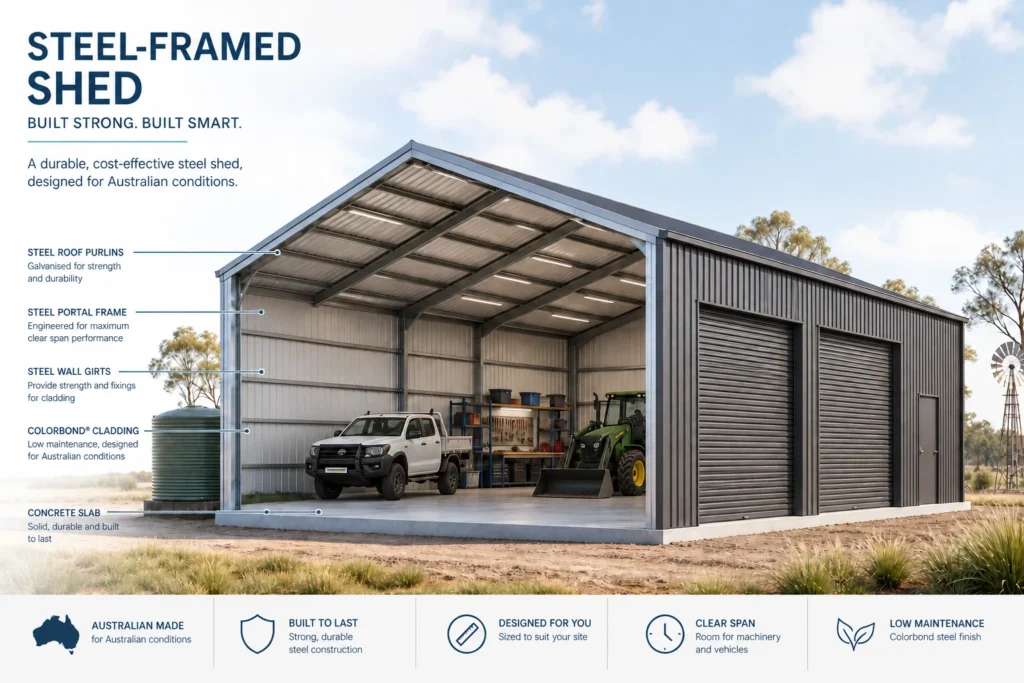
A clear span shed has no posts inside it. The portal frames carry the roof from one wall to the other, so the whole floor is yours for machinery, trucks, hay or a workshop. The question everyone asks next is how wide can it go. The honest answer is that it depends on your site, and here is why.
Why there is no standard size table any more
In the old days the industry worked from tables: this span, this wall height, these bay sizes, pick a row. We do not work that way any more. Every shed we supply is engineered to the wind speed at your site, and the sizing is worked out from there. There are many factors, and many design changes that can be made to get a design to engineer.
Same wind speed, two very different sheds
Here is an example of how flexible that is. In a low wind speed area we can engineer:
- a 30m span with 6m walls, in 6m bays, or
- a 20m span with 6m walls, in 8m bays.
Same site, same wind, two different buildings, both engineered. Trade a little span for longer bays, or the other way around, and the engineering changes with it. That is why a size from a table tells you very little about what your block can take.
What changes the answer
Your site wind speed
This is the starting point for everything. It comes from your exact location, so two properties in the same district can engineer differently. See our cyclone rated sheds guide for how wind regions work.
Span, wall height and bay spacing
These three work together. A wider span, taller walls or longer bays each put more load into the frames, so changing one can be balanced by changing another, as the example above shows.
How the shed is held down
Our standard is on slab bracketry: the slab is poured, then the shed is set out and bolted down onto it. Where the height or the wind speed push the hold down loads high enough, the design moves to cast in brackets, set in the slab before the pour. That one change alters a lot of the engineering, and we tell you at the design stage so it is planned for. More in our slab and foundations guide.
The weight of the Colorbond
Moving to a heavier Colorbond sheet has a huge effect in higher wind speed areas. Think cyclonic.
Cyclonic regions
In cyclonic regions our standard designs stop at a 12m span. Wider than that needs a heavier structural steel design.
So what size do you need?
Start with what is going in it, not with a number. List the machinery, vehicles, bales or benches, how they come in and out, and how much clearance they need. Then put it into the 3D designer and let the engineering tell you the best way to build it on your site. For ideas by use, see:
- What size shed do I need?
- Farm machinery storage shed design
- Hay shed design and storage
- Garaports: designs, uses and how they are engineered
- Steel portal frame buildings explained
Explore Our Shed Range
Farm Sheds · Commercial Sheds · Industrial Sheds · Cyclone Rated Sheds · Design Your Shed in 3D